Showing posts with label mistakes. Show all posts

Thursday, August 28, 2014

Shoulder to Cry On

This week on the Island of Misfit Toys, the Gospel Doctrine lesson was all about Job. It's too bad that we get to spend only one week, one too-brief 40-minute class period on Job and his eponymous book in the Old Testament, because there are so many lessons we can learn from both him and from the people who were close to him.

I had a boil once when I was a eight or nine years old, and it occurred "across the pond" when we were on one of my family's and my trips to England to visit my mom's family. I remember my Aunt Mary, one of the greatest, kindest souls ever to walk this Earth, applying a poultice for multiple nights to help treat it and to bring down the swelling. She always knew what to do.

I can't even imagine what it would have been like to be covered head to toe with boils. And yet, somehow, Job lived to tell the tale.

Specifically, however, tonight I'm not thinking of Job but of the three friends, Bildad, Eliphaz, and Zophar, who came to comfort him when he was in the middle of his afflictions. Upon arriving to visit their old friend, "they sat down with him upon the ground seven days and seven nights, and none spake a word unto him: for they saw that his grief was very great" (Job 2:13).

Later on, of course, as those who are familiar with the story will remember, they made the mistake of berating him for what they perceived to be his sins or errors, and they were chastised for it. Nevertheless, I try to give these three men the benefit of the doubt. They were human, as we all are, and I believe that the simple act of keeping him company for that entire week, just being there with their friend when he needed them, yet not saying a word, did far more good than anything else they could have done at any point during Job's misfortunes.

Thus it is when we mourn, too. A friend (#1) of mine who lost his father far too soon essentially said the same thing recently when he spoke of another friend (#2) of ours, who lost his mother to cancer. Friend #2 was there for Friend #1. He didn't try to console him or to say it would be all right; he was just there, spending time as a friend, to let him know someone cared.

Years ago, Angry White Mom witnessed the slow, painful death of a friend of hers to a debilitating illness, her body literally wasting away until she passed from this life. The night of the friend's funeral, AWM saw me in the kitchen and, needing the same comfort, I suppose, that Job and Friend #1 sought, she simultaneously burst into tears and hugged me tightly, not letting go for what seemed like at least 10 minutes.

Sometimes, you literally need a shoulder to cry on. I'm grateful to have shared that moment with you, Mom. Mainly, I realize I got to share it with her because I was there. It's something I'll never, ever forget, a memory I will always cherish.

Family and friends reading this, I hope you'll consider me "there" for you if you ever need it. That goes for both my recent post about those who struggle with depression, as well as with any other problem or worry under the sun.

I also don't get many hugs like that these days, but I'm willing to give if the need arises.

Ladies especially.

Saturday, June 14, 2014

Benefit of the Doubt

There's something about driving in the rain that makes people's IQs drop by 50 points, I remember thinking this past Thursday afternoon. I was frustrated because I was in a hurry to get somewhere, and what should have been the quickest route had become the most time-consuming one. A brief cloudburst of much-needed summertime rain, and everyone on the road I was driving on slowed to about 20 miles per hour in a 50 MPH zone.

To quote famous stand-up comedian George Carlin (aka Rufus in the Bill & Ted's movies):

"Have you ever noticed that anybody driving slower than you is an idiot, and anyone going faster than you is a maniac?"

I'm sure we're all tempted to feel this way at times. We have our eyes wide open when looking at others' perceived faults and have our eyes half-closed regarding our own.

No more than two minutes later, I turned a corner—and, in the process, I inadvertently cut off someone else, who likely had to press his brakes hard in order to not collide with me. Vertently or inadvertently, I had messed up.

This person, in fact, then changed lanes and pulled up parallel to me at the next stoplight. I turned over to look at him and saw that he was now making eye contact with me, and I mouthed the words, "I'm sorry." He then proceeded to roll down his window to say something back to me.

Dreading or fearing what lewd gesture or comment this person had in store, I was both surprised and relieve to hear him say, with a smile, "It's okay, dude!" He even gave me a thumbs-up sign and drove off as the light turned green.

Whoever you are, random, kind stranger, thank you for reminding me that we all make mistakes, and that forgiveness is always a good option. You didn't let me cutting you off ruin your day.

The next time someone cuts in front of me, fails to signal a turn, or commits any one of a number of "oopsies" in traffic, I would hope to give that person, as this stranger gave me, the benefit of the doubt—that said person is somewhat like me, a reasonably good and safe driver who happens to have just made an innocent mistake rather than some escaped mental patient on the loose, running over curbs and cats and small trees and driving the wrong way down one-way streets and committing other serious and/or scary traffic violations.

For that, we have celebrities.

Friday, November 1, 2013

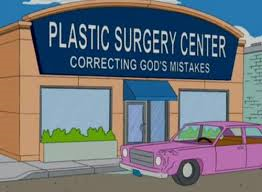
Correcting God's "Mistakes"

I have been a fan of "The Simpsons" since it first went on the air in December 1989. It's a show that has aired during all of part of four decades, folks. And though the program is not as good as it once was, it can still teach some important life lessons through its unique blend of satire and humor.

Recently, I caught a rerun of an episode from a few years back that I hadn't seen before. In it, Homer visits a plastic surgery clinic that contains the subtitle "Correcting God's Mistakes" on its marquee out front.

That's certainly how the Angry White Loner views plastic surgery—as an attempt to fix God's "mistakes." That's also how he views such things as dying his hair until he no longer remembers what color it should be, getting tattoos, wearing toupees, comb-overs, excessive amounts of makeup, tanning, piercings, etc. Please don't get me wrong; I'm not saying that you are evil or wrong if you have pierced ears or dye your hair on a regular basis or have a comb-over, though the lattest certainly may not improve your chances with the ladies. That's just the Angry White Loner's reasoning behind not doing any of those things to his own body.

I relate this concept to Elder Joseph B. Wirthlin's final general conference message before passing away in 2008, a talk titled "Come What May, and Love It." Aging gracefully, as I see it, is certainly one way to accept whatever happens and to embrace it as life goes on. I certainly didn't expect to start losing my hair in my 20s—who ever does?—but I accept it and can roll with it.

But Angry White Loner, you say. You wear glasses. And they're sexy as all get-out. Isn't this one way of correcting a "mistake," as by natural processes,you became nearsighted sometime during the fourth or fifth grade and often cheated on eye tests until finally succumbing and getting contact lenses and, later, glasses?

That's a fair point, but this concept doesn't apply to things to make our lives "better" or "normal." No, I am referring to cosmetic choices.

Even with the many things we might change about our bodies if we only could—weight, height, eye color, hair color, complexion, immune system, handicaps, chronic illnesses, and any and all other "thorn(s) in the flesh" that Paul spoke of—we each have, I hope, at least one or two features of which we are enormously proud. And by this I mean the good kind of proud—the kind of proud that makes us look at a photo of ourselves or in the mirror and then look up to Heavenly Father and say, "Thank you for giving me this feature!"

One such thing I can say that about is being a ginger. Though I no longer have as much hair as I once did, and even though what hair I have left on top is no longer red, I was born with red hair and had red hair for my first few birthdays. Then, by natural processes, my hair turned blond and remained so until I was 11 or 12, and then it changed colors again and became brown and then dark brown. (Odds are, it will change colors once again the older I get, assuming it doesn't all fall out.)

A few years later, when I found that I was able to grow facial hair and no longer worked at a company that required me to be clean shaven, I discovered that I could grow a rather awesome red-haired goatee and/or beard. And it's one of the things I like best about myself, physically speaking.

In summary, I suppose, the point I am trying to make is that God doesn't make junk. Our bodies are by no means perfect, but they are the creations of a perfect being. And that fact, in and of itself, makes us, in a sense, pretty amazing creations.

Tuesday, June 4, 2013

People's Worst Moments

"If you're gonna get mad at me every time I do something stupid, then I guess I'll just have to stop doing stupid things." -Homer Simpson

Do you ever find words, be they oral or written, coming out of your mouth - you don't really know where they're coming from, or they wouldn't be spoken/written by someone like you if you just sat and thought about them rationally for a moment or two first - and find you're regretting them the instant they are uttered? Perhaps just as bad, do you find yourself not saying or doing the things that a trusted friend or colleague would expect you to do? To the friend, the feeling of letdown or betrayal is the same whether these are sins of commission or omission on your part.

I had this very flaw in my own character brought to my attention just last night. I was reprimanded by a friend, someone who trusted me, and the thing is that I deserved every word of it.

She was right, and I was wrong - 100 percent.

I've said it before: I'm a work in progress. I still have a ways to go. And yesterday I learned that the distance I need to travel is still a long ways off. Sometimes, there is just no excuse that isn't a total cop-out; an all-out apology is necessary.

I doubt whether any of us wants to be defined by his or her worst moment. I hope that this friend will not remember by my careless actions or, rather, lack of positive actions, but instead by the good moments we have shared together.

Do you find yourself recalling someone's worst moment(s) when that person's name is mentioned, or you run into that person at the grocery store 15 years later, or whatever the case may be? I have realized that I still do, as much as I try to let go of negative experiences from the past. I felt that way not long ago when one of my seventh-grade tormentors, several years after the fact, made a friend request on Facebook.

Consider the Apostle Thomas, largely referred to as "doubting Thomas" by members of the Christian faith. He is someone who, I think rather unfairly, is certainly remembered by his worst moment. Nevertheless, a wise institute teacher once pointed out a much lesser-known reference to Thomas in the Gospel of John.

Jesus had just learned that Lazarus had died, and He was preparing to return to Judea to see His beloved friend. Concerned that the Jews had recently tried to stone the Savior, however, most of the Apostles warned Him against making the trip. That's when Thomas spoke up and said:

"Let us also go, that we may die with him" (John 11:16).

It sure sounds like Thomas isn't so "doubting" at this point, does it? Like Thomas, we all have our bad moments. Hopefully, they do not outshine the bad ones.

I suppose this is all just to say "thank you" to all of my family members and friends who love and support me in spite of my errors and mistakes, who give me second and third and fourth chances and are patient with me as I work my way through "this vale of tears" (Hymns, no. 116). I don't always do the right thing, but I hope that, on occasion, I can. I hope to return the favor to you.